

You’ve probably seen the big green “Proof of Reserves” badge on exchange pages and thought, great, they’re solvent. Not so fast. PoR is useful, but it’s not a magic stamp of safety.
This guide breaks down what PoR actually proves, where it falls short, and how to read these attestations without getting lulled into false comfort. You’ll get a simple playbook and a few hard-won red flags to keep on your radar.
| Aspect | What to Know |
|---|---|
| What PoR Proves | On-chain assets held at a point in time, often mapped to user balances via a Merkle tree. |
| What It Misses | Off-chain liabilities (fiat, loans), hidden debts, and whether keys are exclusively controlled. |
| Freshness | Typically a snapshot; data can be stale within days and is sensitive to timing. |
| Reserve Ratio | Over 100% suggests asset coverage, but varies by token and excludes non-crypto liabilities. |
| Verification | Users can check inclusion proofs and signed messages; third parties may attest or audit parts. |
| Comparables | Look for frequency, per-asset ratios, methodology, and external review details. |
| Bottom Line | PoR is a necessary signal, not a full solvency audit. Combine with other checks and risk limits. |
Editor’s note: In Q2 2026 I started tagging venue risk to our trade tickets, and PoR snapshots became a surprisingly handy input. I watched a few exchanges post strong per-asset ratios while stablecoin weights crept higher week to week. Desk chats mirrored it: funds were comfortable with snapshots and signed messages, but they still diversified venues and kept hot balances tight. The biggest win wasn’t a single ratio; it was catching timing quirks around snapshots and trimming exposure ahead of busy weekends. PoR helps, but only when you treat it like live market data, not a certificate on the wall. — Idris Calloway
Proof of Reserves (PoR) is a way for an exchange or custodian to show it actually holds the crypto it owes users. Usually there’s a public list of wallets or a signed message from known addresses. Then there’s a “proof of liabilities” side that tallies user balances (often hashed into a Merkle tree) so outside parties can verify totals without revealing everyone’s account.
Think of it like a photo of the vault at noon. Helpful, yes. But it doesn’t tell you about the bank loan due at 4 p.m., or whether someone borrowed the keys for the morning. PoR is strongest on the assets side and weakest on hidden or off-chain liabilities, which is why it’s a piece of the trust puzzle, not the whole thing.
There’s real scale behind these disclosures. In its June 2026 Exchange Monthly Report, CoinMarketCap tracked about $192.6 billion in exchange PoR, down 5.3% month over month, and highlighted USDT as the single largest reserve asset at roughly $57.6B, with BTC around $55.5B (CoinMarketCap (Crypto Exchange Monthly Report)). Those numbers tell you which assets dominate customer balances and the risk exposures tied to them.
But limits remain. As The Block’s July 2026 primer puts it, PoR is usually a point-in-time snapshot, can be gamed by moving funds just before the check, doesn’t capture fiat or other off-chain liabilities, and can’t fully prove exclusive key control (The Block (research primer)). In other words, necessary but not sufficient.
Key terms, quickly
- Proof of Reserves (PoR): A disclosure showing on-chain assets held to back customer balances at a specific time.
- Proof of Liabilities (PoL): The method for totaling user balances, often using a Merkle tree so users can verify inclusion without exposing others.
- Merkle Tree: A cryptographic data structure that lets you prove your account is included in the total liabilities with a short proof.
- Reserve Ratio: Assets divided by liabilities for a given token; above 100% implies more assets than customer claims for that token.
- Attestation: A third-party review (not a full audit) that checks the snapshot and methods used to present PoR data.
- Signed Message: A cryptographic signature from a wallet proving the exchange controls that address at the time of the snapshot.
Step-by-Step Playbook
- Start with frequency and scope. Prefer exchanges that publish PoR regularly and by asset, with clear methods for both assets and liabilities.
- Check the snapshot date. If the report is weeks old, treat it like stale milk. Markets move; you need current data to trust ratios.
- Read per-asset reserve ratios. A 120% ratio in BTC isn’t the same as 102% in USDT. Look for outliers and thin coverage in long-tail tokens.
- Verify the on-chain piece. Click through addresses, confirm signed messages, and see if balances match the attestation.
- Test your inclusion. If the exchange offers Merkle proofs, download yours and verify it includes your balance in the liabilities total.
- Scan for timing games. Compare wallet flows around the snapshot. Big in-and-out movements within 24 hours can be a smell test failure.
- Cross-check with independent data. Compare multiple sources and, if possible, use on-chain explorers or third-party dashboards to validate holdings.
- Limit venue risk. No single platform should hold all your funds. Keep trade balances lean and move long-term holdings to self-custody.
What PoR Proves vs What It Misses
PoR is great at answering a narrow question: did the platform control these specific crypto assets at the time of the snapshot? If the answer is yes, and liabilities math checks out, you’ve cleared a meaningful bar.
Where it stumbles is everything else. Fiat balances sitting at banks, lines of credit with lenders, rehypothecation deals, insurance coverage, or legal claims — these usually aren’t in scope. Even key control can blur if funds were briefly borrowed for show. That’s why the best posture is “trust, then verify, then diversify.”
It helps to look at how different venues present themselves. In July 2026, Phemex reported an average reserve ratio of 127.77% across BTC, ETH, USDT, and SOL, with per-asset figures like BTC 112.24% and ETH 149.50% (Phemex (press release via GlobeNewswire)). Meanwhile, MEXC’s July update, audited by Hacken, showed a BTC reserve ratio rising to 281%, covering 4,439.51 BTC of user holdings (MEXC (press release)). Ratios over 100% can be comforting, but they’re not all the same story. Ask how liabilities were computed and whether non-crypto exposures exist off to the side.
Pro tip: don’t just read the headline ratio. Drill into the methodology and the timing. A clean PoR that coincides with massive wallet shuffles is a yellow flag, not an all-clear.
The Block’s research note in July 2026 spelled out the core caveat: PoR is a point-in-time check, can be gamed by timing wallet moves, and can’t on its own prove exclusive key control or capture off-chain liabilities (The Block (research primer)). Treat it like a weather report, not a climate model.
Snapshot vs Real-Time vs Audit
Not all disclosures are created equal. You’ll see three broad patterns in the wild: classic snapshots, near real-time dashboards, and full financial audits. Each has trade-offs.
| Approach | Scope | Frequency | Liabilities Coverage | External Assurance | What You Learn |
|---|---|---|---|---|---|
| Snapshot PoR | On-chain assets at a moment in time | Periodic (days to months) | Often Merkle-based, may be partial | Attestation common, audit rare | Point-in-time asset sufficiency per token |
| Real-Time Reserves | Live wallets, automated updates | Continuous or daily | Varies; liabilities may still be periodic | Mixed; some third-party monitoring | Faster signal on asset movements |
| Financial Audit | Balance sheet, controls, fiat accounts | Annual or semi-annual | Yes, including off-chain items | Formal accounting standards | Broader solvency picture and controls |
In practice, you’ll often get a hybrid: a snapshot PoR plus sporadic wallet feeds. That’s fine if you combine it with your own monitoring, but don’t confuse a slick dashboard with a full audit. Different tools, different promises.
Fitting PoR Into Your Workflow
For retail traders, the simplest approach is to use PoR as a venue filter, not a safety certificate. If two platforms are otherwise similar, pick the one that publishes frequent, verifiable PoR with per-asset detail and independent review. Then keep balances lean and withdraw often.
For pros, PoR can be an alerting input. Big swings in an exchange’s wallets, or a sudden change in a per-asset ratio, can signal risk or just operational churn. Combine PoR data with your liquidity needs, banking rails, and counterparty exposures. And if your strategy depends on a single venue, that’s a strategy problem first, a PoR problem second.
At the market level, PoR composition tells a story. CoinMarketCap’s June 2026 report shows USDT as the largest reserve asset by dollar value and BTC right behind it (CoinMarketCap (Crypto Exchange Monthly Report)). If stablecoins dominate reserves, you inherit their issuer and banking risks; if BTC or ETH dominate, you inherit their price and network risks. Different, not necessarily better or worse.
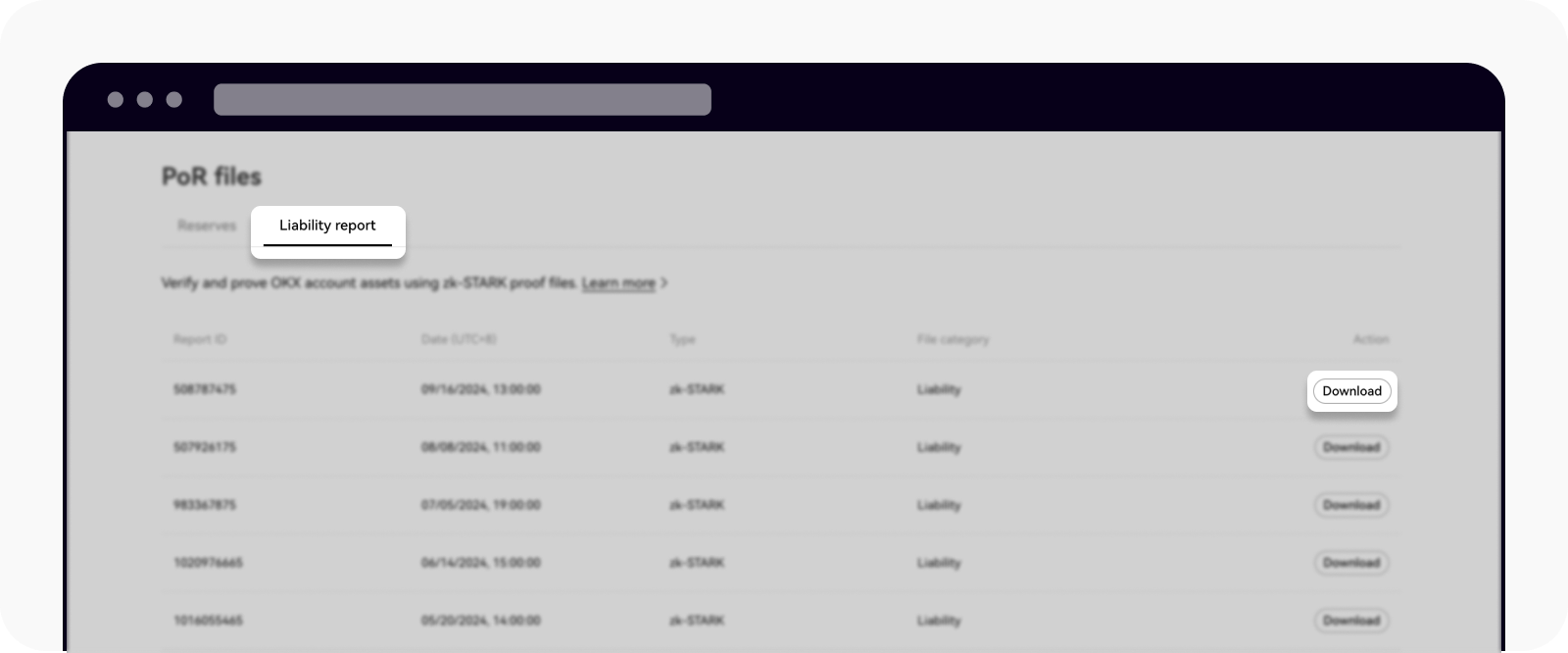
Screenshot of OKX’s Proof-of-Reserves UI showing the ‘Liability report’ / downloadable zk‑STARK proof file — demonstrates how exchanges publish verifiable proof files users can download and run for independent verification. — Source: OKX (help / PoR guide)
Pitfalls & Red Flags
- Long gaps between reports. If PoR shows up quarterly at best, you’re flying blind most of the time.
- No liabilities methodology. Assets without a clear proof-of-liabilities process can mask shortfalls.
- Snapshot-week wallet gymnastics. Large inflows just before, and outflows right after, the snapshot deserve extra scrutiny.
- One big omnibus wallet. Zero address diversity and unclear key control make it harder to verify custody practices.
- Selective coverage. Great ratios on flagship coins but silence on long-tail tokens may hide risk pockets.
- Overreliance on third-party credit. If an exchange leans on custodians or lenders, ask how that affects key control and withdrawal liquidity.
If you want more plain-English breakdowns of market structure topics like this, we cover them regularly at Crypto Daily. No fluff, just the parts that matter for your positions.
Frequently Asked Questions
Does a 100% reserve ratio mean my funds are safe?
It means on-chain assets matched user liabilities at the snapshot for that token. It does not account for off-chain liabilities, future losses, or operational risks. Treat it as one green light, not the whole traffic system.
How can I verify an exchange’s PoR myself?
Check that you can retrieve a Merkle proof for your account, verify signed messages from known wallets, and match balances on-chain. If those pieces aren’t available, mark the disclosure down a notch.
Why do some assets show higher reserve ratios than others?
Liabilities vary by asset, and some wallets are overfunded to buffer flows. You’ll also see differences if the platform uses separate custody setups per coin. Always compare like-for-like per asset.
Can exchanges game PoR?
They can time wallet movements around a snapshot or borrow assets temporarily. That’s why frequency, independent review, and your own on-chain checks matter. The limitations are well documented by independent researchers.
Is real-time reserve tracking better than snapshots?
It’s better for freshness on the assets side, but it often lacks real-time liabilities data. Use it as an earlier signal, not a replacement for sound methodology.
What should I do with this info as a trader?
Favor venues with transparent, frequent PoR, keep balances minimal, and diversify custody. None of this is financial advice; it’s just practical risk hygiene in a volatile market.
Why do reports highlight USDT and BTC so much?
Because they’re usually the largest line items. In June 2026, USDT slightly edged BTC as the top reserve asset by dollar value on tracked venues, which shapes the risk mix users collectively face.
Disclaimer: This article is provided for informational purposes only. It is not offered or intended to be used as legal, tax, investment, financial, or other advice.
Credit: Source link