

- The Ethereum price resilient above the $2,345 support, signals a potential 7.85% surge, before buyers challenge key channel resistance.
- Blockchain tracker Arkham Intelligence flagged a prominent whale moving roughly 3,000 ETH to centralized exchanges in two separate transfers on May 5.
- Deribit’s Ethereum options market currently reflects weak expectations for major volatility across most contracts extending into late July.
ETH, the native cryptocurrency of smart contract giant, Ethereum, is up 1.5% during Tuesday’s U.S. market session to trade at $2,382. The uptick follows the broader market momentum as Bitcoin reclaimed the $80,000 psychological level amid the de-escalating tension in the middle east. Despite the price appreciation, Ethereum coin faces a risk of renewed selling pressure as on-chain data high significant profit-taking from a prominent whale.
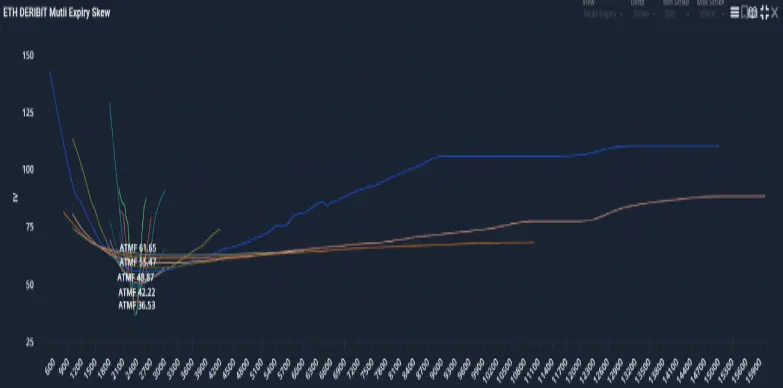
The activity coincides with a notable shift in ETH’s option market which projects negative outliers in forward and ATM implied volatility for multiple expirations. In addition, a notable discount in long-dated futures contracts of ETH signals weak conviction in buyers, reinforcing the narrative for temporary upswing before the next breakdown.
Ethereum Whale Cashes Out as ETH Jumps Higher
The blockchain analytics platform, Arkham Intelligence, recently highlighted a notable profit-taking transaction from a prominent whale wallet, 0x237B…FB6aAb. The wallet owner transferred approximately 3,000 ETH in two different transactions on May 5th, transferring about 2,000 coins to an OKX deposit address and another 1,000 to Binance worth a combined $7.15 million at the prices of the day.
This coincided with a slight increase in Ethereum price that day, recording a spike from $2,350 and $2,390. It is not clear whether the price movement precipitated the decision or was just coincidental with the decision but the track record of the wallet indicates a measured approach as opposed to reactive selling.
Over the lifetime of the wallet – since its first recorded transaction on 30 December 2022 – the operator has experienced a series of buying and selling cycles. The broader pattern shows a wave of heavy outflows in late March 2026, a pause, then fresh buying activity returning in early April and again at the start of May. The last sell-off is preceded by an accumulation window which opened around April 11th and lasted about three weeks before it was unwound.
The numbers crunch out the real story: an average entry around $2,580 versus an average exit around $3,020, resulting in an approximate of 72.98 million realized gains. With close to 94% of the position now liquidated, whoever controls this wallet has extracted the bulk of their profit and appears to be in the final stages of closing out this particular trade cycle entirely.
Historically, whale selling has often coincided with local top or renewed correction trend, signaling a potential downswing in Ethereum price.
Deribit Options Signal a Calm Ahead, With One Near-Term Exception
The options market in the Ethereum is sending a mixed signal, depending on where you are on the calendar. In a series of contracts spanning late May through the end of July, both forward and at-the-money implied volatility are below their anticipated levels – a signal that traders who position in those windows are not hedging against a significant amount of movement.
The short term view is otherwise. The May 6th expiration is unique with a higher at-the-money implied volatility and a skew in the direction of calls. Whoever is trading in that contract is either hedging against an overnight spike, or is making a directional bet that something will move before the end of the day tomorrow. The market becomes silent after that date.
ETH Futures Curve Shows Cracks Ahead of June Expiry
The June 26th Ethereum futures contract on ETHUSD_260626 is trading below spot, and the basis is compressing to 1.913. When in a market where futures are usually priced above current prices, the flipping, or tightening, of the relationship becomes notable.
Long-dated traders are not paying up on forward exposure that historically represents a deceleration of directional enthusiasm, but not actual panic. The June expiry is too far off that putting it there would represent thoughtful opinions and not reactive hedging.
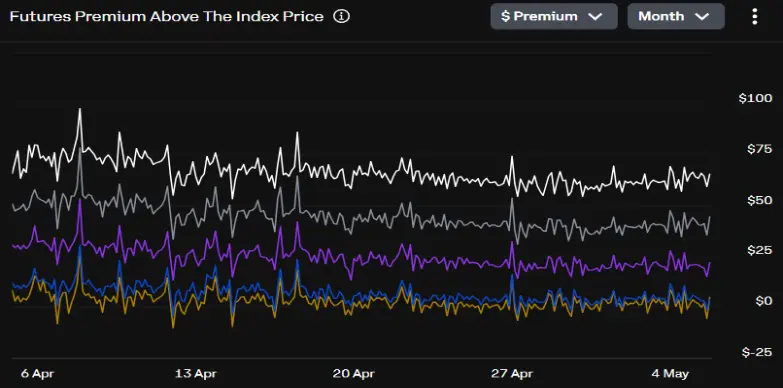
The compressed basis sits alongside the softer implied volatility readings seen across Deribit’s longer-dated options, painting a consistent picture of muted conviction heading into summer.
Ethereum Price Drives a Steady Recovery Within Channel Pattern
In the past three months, the Ethereum price showed a slow yet steady recovery above the $1,800 support. Interestingly, the price rally resonated strictly within two parallel trendlines, indicating the formation of a rising channel pattern.
The chart setup offers dynamic resistance and support to price, driving a directional acceleration. Amid the recent recovery, the Ethereum price reclaimed the 20-and-50-day exponential moving average, reinforcing the renewed recovery in the market.
Currently trading at $2,371, the Ethereum ETH0.70% coin is just 7.65% away from challenging the pattern’s resistance trendline at $2,533. The 200-day EMA slope wavering close to this resistance, creates a strong resistance zone for buyers.
Therefore, the potential breakout would have a higher impact in price, bolstering a stray recovery to $3,045, followed by a leap towards $3,400.
However, a deeper analysis into ETH’s technical chart shows a significant drop in trading volume despite price recovery. This suggests weak conviction or less interest from traders to commit towards a long/buy position in the market.
Therefore, the Ethereum price faces a risk of renewed selling pressure at the channel resistance. If the sellers continue to defend the overhead trendline would revert and prolong this slow paced recovery.
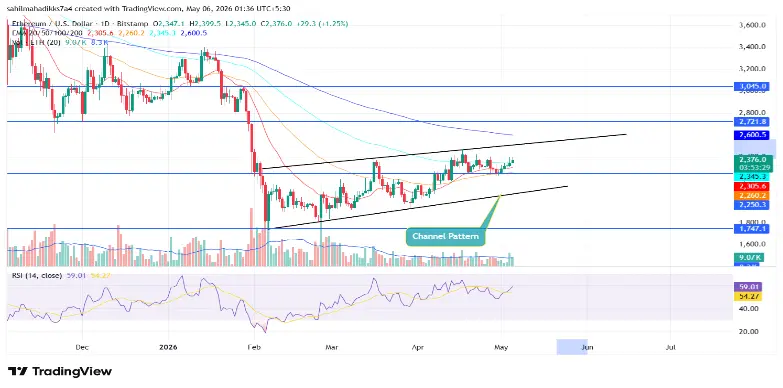
Under a pessimistic condition, the Ethereum price could breach the bottom trendline of the pattern. With sustained selling, the post-breakout fall could drag the asset roughly 19% from the breakdown point to retest the $1,750 support.
Credit: Source link