

AI agents don’t wait for banking hours. They quote, buy, renew, and tip in seconds. The practical question for product teams now is which rails should these agents use by default. Today, USDC on x402 has the momentum. Ripple is betting XRP and its dollar stablecoin, RLUSD, can be competitive where speed, costs, and compliance matter.
This article cuts through the noise. If you’re deciding what to integrate for autonomous payments, you’ll find a clear view of the market reality, what Ripple is shipping, and how to test a dual‑asset strategy that won’t strand you away from liquidity.
| Aspect | What to Know |
|---|---|
| Market traction | USDC leads x402 flows across many chains; cumulative x402 transactions exceed 120M across 14 chains, with Base and Solana dominant (CoinDesk). |
| Ripple’s new tooling | Ripple launched the XRPL AI Starter Kit with support for x402‑powered payments using XRP and RLUSD, aimed at agent developers (Ripple (XRPL AI Starter Kit)). |
| Stablecoin reserves | As of 2026‑05‑28, RLUSD circulating is $1.731B with $1.833B in reserves per Ripple’s attestation (Ripple (RLUSD Transparency)). |
| Where usage clusters | Base accounts for ~70M x402 transactions and Solana ~45M, while USDC volume on x402 tops $41M to date (CoinDesk); Chainalysis highlights Base’s sharp ramp from near‑zero to 100M+ agentic txs by Q1’26 (Chainalysis). |
| Costs and speed | XRPL, Base, and Solana all offer low fees and fast finality; the right choice hinges on liquidity, tooling, and compliance needs rather than raw latency claims. |
| Adoption strategy | A dual‑rail approach (USDC + RLUSD/XRP) can capture liquidity today while positioning for XRPL’s improvements and Ripple’s enterprise push. |
x402 has emerged as a common pattern for “agentic” payments: autonomous software actors exchange on‑chain value using predictable, machine‑readable flows. Think of it as a minimal, interoperable handshake and settlement approach that lets bots, apps, and services pay one another in small, frequent increments without manual coordination. In practice, markets have coalesced around stablecoins—chiefly USDC—because consistent dollar value smooths out automation.
Ripple’s counter is twofold. First, XRP remains a fast, liquid L1 asset on XRPL that can serve as a native settlement token when agents don’t require fiat equivalence at every hop. Second, RLUSD provides the stablecoin leg for dollar‑denominated use cases, backed by a reserve program that Ripple reports monthly. Together, XRP and RLUSD give builders a choice: speed and native liquidity with XRP, or price stability and enterprise‑friendly attestations with RLUSD.
Why does this matter? Network effects. Agents tend to converge where their counterparties already are and where the toolchain is mature. Today, that’s USDC on chains like Base and Solana. For Ripple to challenge that, it needs frictionless developer tooling, credible stablecoin assurances, and bridges into the ecosystems with the most active agents. The XRPL AI Starter Kit is a notable step toward that developer ergonomics target.
Key terms at a glance
- x402 — An emergent, cross‑chain agent payment pattern enabling standardized, automated on‑chain transactions by software agents.
- AI agent — A software process that acts autonomously within a defined policy to purchase, subscribe, tip, or otherwise transact.
- RLUSD — Ripple’s dollar‑pegged stablecoin designed for XRPL and other environments; Ripple publishes reserve attestations monthly.
- XRP Ledger (XRPL) — A layer‑1 blockchain emphasizing low fees and fast settlement, with native DEX and issued asset support.
- Network effect — The self‑reinforcing dynamic where more users and integrations draw even more users, cementing liquidity and standards.
- Finality — The point at which a transaction is irreversible; important for agents making rapid, repeated payments.
Step‑by‑Step Playbook
- Map your agent’s payment graph. List who the agent pays, how often, in what amounts, and the required denomination (fiat vs. crypto). This defines asset choices and limits.
- Choose a primary and fallback rail. Default to where counterparties live (often USDC on Base/Solana) and set XRPL (XRP/RLUSD) as a backup or for select flows to test costs and reliability.
- Integrate the XRPL AI Starter Kit. Use Ripple’s kit to wire up x402 payment logic with XRP and RLUSD while keeping an abstraction layer to swap assets without rewriting business logic (Ripple).
- Define rate limits and policies. Cap per‑minute spend, merchant whitelists, and retry logic. Agents must fail safe: no unlimited loops, no uncapped slippage or gas.
- Provision stablecoin liquidity. If you settle in dollars, maintain RLUSD and USDC buffers. Automate rebalancing to the chain where payments cluster to reduce bridging.
- Stand up observability. Instrument x402 request IDs, confirmations, and exception paths. Track fail/settle ratios and cost per successful payment across chains.
- Run an A/B pilot. Split a portion of agent flows across your primary rail and XRPL. Compare latency, fees, acceptance, dispute rates, and support overhead over 2–4 weeks.
- Document compliance and custody. Maintain records for RLUSD attestations, counterparty checks, and custody procedures—especially if operating at enterprise scale.
Where the Liquidity Is Today vs. Ripple’s Bet
By any reasonable metric, USDC owns the mindshare for x402. CoinDesk, citing Web3 Trackers, reports more than 120 million cumulative x402 transactions across 14 chains with over $41 million in USDC volume settled via x402; Base tallies around 70 million transactions and Solana about 45 million (CoinDesk).
Chainalysis separately notes that Base grew from near‑zero in mid‑2025 to well over 100 million cumulative agentic transactions through Q1 2026, underscoring how quickly adoption can compound once developer tooling and liquidity align (Chainalysis).
Ripple’s counterpoint rests on two pillars. First, RLUSD’s transparency and scale: Ripple’s May 28, 2026 attestation shows $1.731B in circulating RLUSD backed by $1.833B in reserves (Ripple). Second, the XRPL AI Starter Kit, which promises a faster on‑ramp for agent developers who want XRPL’s settlement characteristics with either XRP or RLUSD (Ripple).
| Criteria | USDC on Base/Solana (x402) | XRP/RLUSD on XRPL (x402) |
|---|---|---|
| Liquidity today | High adoption and counterparty acceptance; concentrated activity documented across 14 chains with notable Base/Solana clusters (CoinDesk). | Emerging; hinges on RLUSD distribution and XRPL integrations. Starter Kit reduces dev friction. |
| Tooling maturity | Robust SDKs, onramps, and analytics common on Base/Solana; many vendors default to USDC. | Improving; XRPL AI Starter Kit and ecosystem libraries help, but vendor defaults may lag. |
| Fees & finality | Low fees and fast confirmation on both chains; finality models differ but are agent‑friendly. | XRPL offers low fees and quick settlement; suitable for micro‑payments and frequent calls. |
| Stablecoin assurances | USDC has multi‑jurisdictional visibility and established attestations. | RLUSD publishes monthly reserve attestations showing assets in excess of circulation (Ripple). |
| Cross‑chain reach | Broad presence across x402‑enabled chains; network effect benefits. | XRPL‑centric today; interop depends on bridges, custodians, or routing services. |
| Enterprise comfort | Well‑trodden vendor ecosystem and compliance playbooks. | Appeal for Ripple‑aligned enterprises; attestations and tooling may ease procurement. |
Pro tip: Ship to where counterparties already accept payments, but keep your agent’s payment engine asset‑agnostic so you can toggle between USDC, RLUSD, and XRP without rewriting business logic.
Integration Patterns: Single‑Asset, Dual‑Asset, or Router‑Based
There’s no one right answer for agent payments—there are patterns that fit different risk, liquidity, and compliance appetites. Three practical blueprints stand out.
Single‑asset default. If your counterparties are concentrated on Base or Solana and quote in dollars, a USDC‑only flow keeps architecture lean. You minimize cross‑chain complexity and focus on rate limits, retries, and observability. The downside is vendor lock‑in and potential fee or outage exposure if a single chain gets congested.
Dual‑asset active/passive. Choose a primary rail (often USDC) with XRPL (XRP/RLUSD) as an active backup. Your agent attempts the preferred route; if quotes or health checks fail, it retries on XRPL. This lets you test Ripple’s stack in production with bounded risk, and it gives finance teams an option to rebalance liquidity to XRPL when spreads or incentives favor it.
Router‑based abstraction. Treat assets and chains as commodities behind an internal router or a third‑party payments broker. The router accepts a standard x402 intent and selects the best rail based on counterparty support, latency, fee estimates, and inventory. This requires more engineering but future‑proofs you if liquidity migrates toward RLUSD or if new chains capture agent activity.
Risk, Compliance, and Day‑Two Operations
Agent payments compress risk cycles. Thousands of micro‑transactions mean small mistakes multiply fast. A sober operational plan matters more than the headline TPS figure.
- Custody and permissions. Decide who holds keys and under what policy. Hardware‑backed keys with explicit spend allowances per agent process reduce blast radius.
- Compliance posture. If you pay regulated entities or face enterprise procurement, maintain documentation for RLUSD attestations and your KYC/KYB process for counterparties. Set geofencing rules per rail if needed.
- Bridging and interop. Minimize trust in bridges by rebalancing inventory natively where possible. Where bridging is unavoidable, enforce circuit breakers by size and frequency.
- Rate limiting and throttling. Implement per‑merchant, per‑minute caps and backoff strategies. Flag abnormal burst patterns before funds exit hot wallets.
- Observability and forensics. Correlate x402 intents with on‑chain hashes. Keep a searchable trail for disputes, chargebacks (if any), and finance reconciliation.
The good news: XRPL, Base, and Solana all offer agent‑friendly settlement characteristics. The difference is less about raw speed and more about where your partners are and how easily you can prove controls to risk teams.
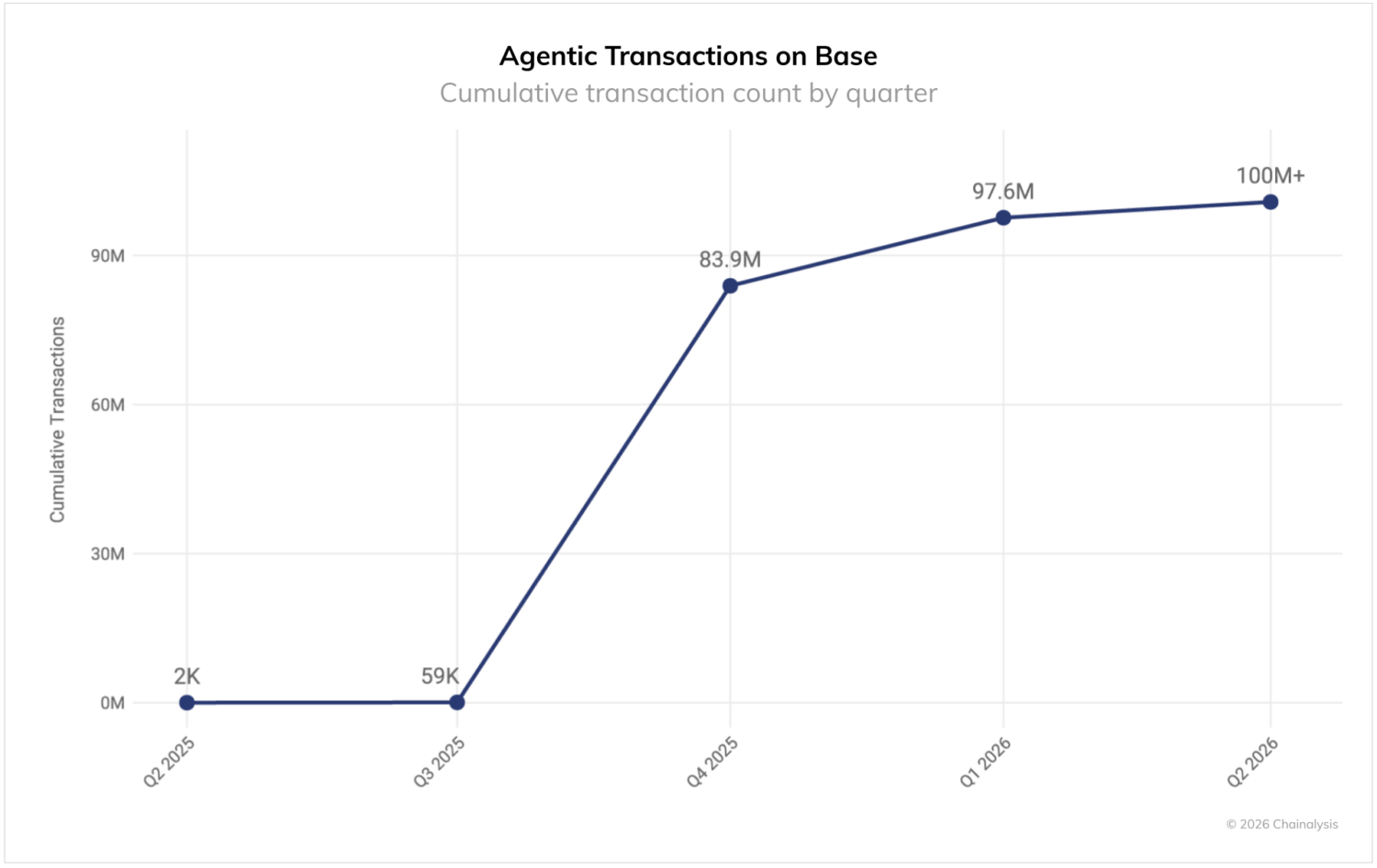
Chainalysis chart: cumulative x402 (agentic) transaction count on Base by quarter (shows the surge to 100M+ by Q1 2026) — useful evidence of early scale and concentration of agentic payments on Base. — Source: Chainalysis
Pitfalls & Red Flags
- Chasing the wrong network effect. Integrating where counterparties aren’t creates silent failure. Verify where merchants actually accept x402 today.
- Under‑provisioned stablecoin buffers. Thin RLUSD or USDC inventory leads to failed payments and costly bridging during spikes.
- Unbounded agent policies. Lack of spending caps, whitelists, or timeouts turns minor bugs into solvency issues under high frequency.
- Opaque attestations or custody. If you rely on a stablecoin, keep attestation and custody evidence on file; avoid unsupported or unreviewed issuers.
- Bridge overuse. Excessive cross‑chain hops add fees, latency, and smart‑contract risk. Prefer native settlement on the chain of highest acceptance.
- Ignoring support load. Every failed micro‑payment can trigger user support tickets. Track failure modes and proactively message customers.
For ongoing analysis and clear reporting on where agent payments are actually settling week to week, Crypto Daily tracks the data and narratives that move adoption. Visit Crypto Daily for coverage across stablecoins, L1s, and emergent payment rails.
Frequently Asked Questions
Is x402 a formal standard or just an emerging pattern?
Today, x402 functions as an emergent pattern for interoperable, agent‑triggered payments across multiple chains. Tooling and messaging conventions are converging in practice, especially around stablecoin flows, but formal standardization is still evolving.
Why would I add RLUSD or XRP if USDC already works?
Diversification and optionality. USDC’s network effect is real, but RLUSD offers a transparent, attested dollar option aligned with Ripple’s ecosystem, and XRP can serve non‑fiat micro‑settlement needs. A dual‑rail design can reduce single‑vendor exposure and position you for shifts in liquidity.
How strong is RLUSD’s backing?
Ripple’s May 28, 2026 transparency report lists $1.731B in circulating RLUSD against $1.833B in reserves, per their monthly attestation. Always review the latest attestation and any independent audits before relying on a stablecoin’s backing.
Where are most x402 payments happening now?
Public reporting points to concentration on Base and Solana, with total x402 transactions above 120M across 14 chains and USDC volumes exceeding $41M so far. Chainalysis highlights Base’s rapid growth from 2025 into Q1 2026.
What about fees and latency on XRPL vs. Base/Solana?
All three are cost‑efficient with quick settlement—differences exist, but for most agent use cases the deciding factor is counterparty acceptance and tooling maturity rather than micro‑seconds of latency.
How do I avoid being locked into one asset or chain?
Abstract your payment engine. Define x402 intents at the app layer and route to USDC, RLUSD, or XRP based on policies and liquidity. Keep per‑rail adapters and a health‑checked fallback path.
Is this suitable for regulated enterprises?
It can be, with the right controls. Maintain custody policies, rate limits, audit trails, and documentation (including stablecoin attestations). Work with counsel to align rails to your jurisdiction and counterparties.
Disclaimer: This article is provided for informational purposes only. It is not offered or intended to be used as legal, tax, investment, financial, or other advice.
Credit: Source link