

Bitcoin price traded near $62,800 on Monday after slipping about 1.5% over 24 hours, according to crypto.news market data.
Summary
- Bitcoin stayed above key support while war fears drove sharp losses across major traditional markets.
- Spot Bitcoin ETFs attracted $197 million, ending eight straight weeks of net investor withdrawals overall.
- Analysts see $65,000 as resistance, while weaker exchange flows may limit near-term breakout attempts again.
The move kept the largest crypto above the $60,000 support area, even as the latest U.S.-Iran strikes triggered sharper moves across oil, stocks, bonds and gold. Ether traded near $1,779, XRP stood around $1.08 and Solana changed hands near $76.40.
Crypto prices weakened, but they avoided the steep losses seen in several Asian equity markets. Bitcoin’s limited reaction contrasted with its sharp selloffs during earlier rounds of conflict this year.
Brent crude climbed more than 4% to about $79.31 a barrel as traders assessed threats to shipping through the Strait of Hormuz. Gold fell about 1.5% toward $4,060 as higher Treasury yields reduced demand for assets that pay no interest.
Japan’s Nikkei dropped 2.2%, while South Korea’s KOSPI lost 7.6%. The two-year U.S. Treasury yield reached its highest level since early 2025 as markets raised expectations for tighter Federal Reserve policy.
U.S.-Iran attacks revive oil and inflation concerns
The latest market moves followed another exchange of attacks between the United States and Iran. U.S. Central Command said its forces struck dozens of Iranian military sites after Iran attacked a container ship near the Strait of Hormuz.
Iran again claimed control over the waterway, while U.S. officials said the route remained open. Those statements remain disputed, and shipping data showed traffic through the strait stayed limited.
The route carried about one-fifth of global oil and liquefied natural gas flows before the war, making any disruption important for energy prices. Higher oil can raise transport and production costs, which may keep inflation elevated.
Minutes from the Federal Reserve’s June meeting showed that a few officials saw a case for raising rates, although they supported holding the target range at 3.5% to 3.75%. Officials also listed Middle East conflict and energy prices among the risks that could keep inflation high.
Bitcoin ETF inflows provide support after eight weak weeks
U.S. spot Bitcoin ETFs recorded $197 million in net inflows from July 6 through July 10, ending eight straight weeks of withdrawals, according to SoSoValue data. The reversal followed $527 million in outflows during the shortened week ending July 2.
Source: SoSoValue
BlackRock’s IBIT led the latest weekly inflows with about $292 million, while Grayscale’s smaller Bitcoin trust added roughly $95 million. GBTC recorded about $108 million in withdrawals, leaving demand uneven across individual funds.
As crypto.news previously reported, Bitcoin ETF selling had removed a key source of demand during the June decline. The return to weekly inflows supports the recovery from the $58,000 to $60,000 area, but the total remains modest compared with the money withdrawn during the previous eight weeks.
Bitcoin also failed to hold above $65,000 after several tests, showing that fund inflows have not yet produced a clear breakout.
Bitcoin indicators improve but $65,000 remains key
Bitcoin’s recent structure remains sideways to slightly positive after the late-June bottom. The price has stayed above the main support zone near $60,000, while sellers continue to defend the area around $65,000.
The relative strength index stands near 47, close to its moving average and below the neutral 50 level. That reading shows that buying pressure has improved from oversold conditions but has not taken control of the market.
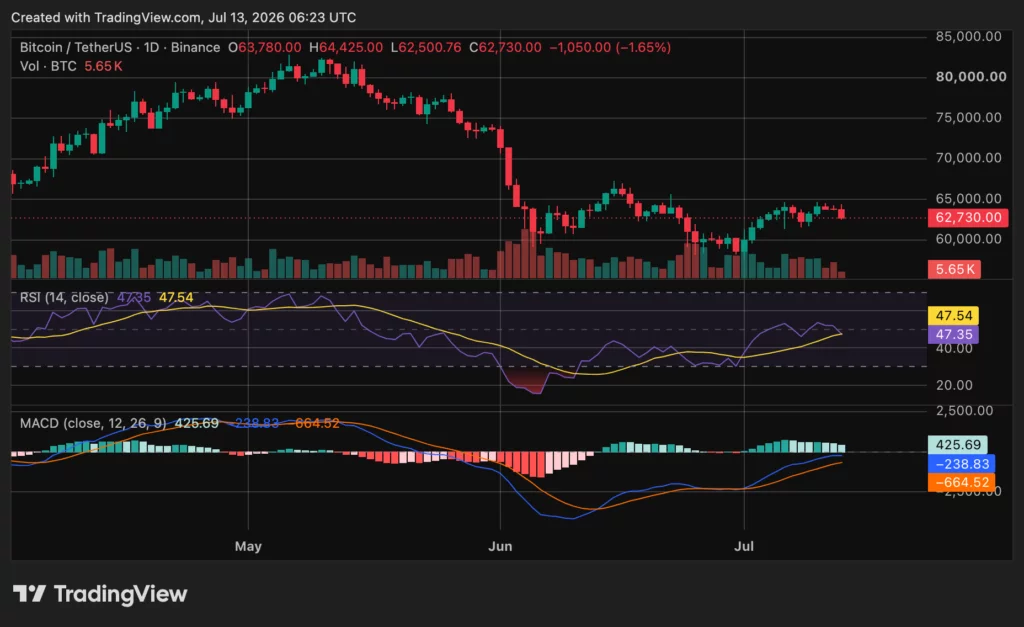
The moving average convergence divergence indicator also shows an early recovery. Its histogram remains positive, and the MACD line sits above the signal line. Both lines remain below zero, which means the wider trend has not turned firmly positive.
A daily close above $65,000 would improve the technical setup and open the way toward higher resistance. A fall below $60,000 would weaken the recovery and return attention to the June lows.
In addition, Crypto analyst Crypto Patel said exchange-to-exchange Bitcoin flows fell 91% in 30 days, from 1,800 BTC on June 14 to 166 BTC on July 12. He linked the decline to European users moving away from Binance after the exchange lost access to regulated services in the European Union under MiCA.
He called the move “the Bitcoin signal almost everyone missed,” but the flow figures and the claimed direct link have not received independent confirmation.
Binance suspended several services for European Union users on July 1 after failing to secure a MiCA license before the deadline. The exchange kept withdrawals available and said it planned to seek authorization in another member state.
Patel said flows above 800 to 1,000 BTC could show that European liquidity had settled on new venues. For now, Bitcoin remains inside its recent range while traders watch ETF demand, exchange liquidity, oil prices and the next Federal Reserve decision.
Disclosure: This article does not represent investment advice. The content and materials featured on this page are for educational purposes only.
Credit: Source link