

Rollups promised scale without throwing away Ethereum’s security. Then came the awkward bit: most of them still relied on one sequencer to decide who gets in next. Based rollups are the pushback to that.
Here’s the idea in plain terms. Instead of trusting an L2-run server to order your transaction, you let Ethereum’s own block proposers do it. The base layer sets the order. The rollup derives its chain from that order. No central sequencer in the middle.
That sounds tidy. In practice, it shifts power, latency, and MEV in new ways. Let’s unpack how it works, what you gain, where the rough edges are, and what we learned from Taiko’s bumpy but informative summer.
| Point | Details |
|---|---|
| Who sequences | Ethereum L1 proposers order L2 batches; the rollup follows that order to build its L2 blocks. |
| Main upside | Removes a single L2 sequencer as a censorship or liveness bottleneck; inherits Ethereum’s proposer set. |
| MEV shift | Value extraction moves toward L1 builders/proposers and relays under PBS; L2 preconfirmations become a market. |
| UX tradeoffs | 12-second slot rhythm, preconf reliance, and occasional reorg risk; latency tied to L1 conditions. |
| Security still matters | Proof system, data availability, and bridges remain critical. Based sequencing doesn’t fix weak proofs or leaky bridges. |
| Real-world signal | Taiko’s post-incident upgrades and bridge recovery underline how governance and proofs interact with based designs. |
What “based rollups” actually mean
At a high level, an L2 has to decide two things: the order of transactions and whether the resulting state is correct. Based rollups punt the first job to Ethereum. They keep the second with cryptography and verification.
The minimal recipe
- Ordering: L2 batches are committed on Ethereum. Whichever batch ordering lands on L1 is canonical for the L2.
- Execution: The L2 executes those ordered transactions according to its rules, then posts proofs (ZK or fraud proofs) and data.
- Derivation: Anyone can reconstruct the L2 state from L1 data. That’s your neutrality anchor.
What it is not
- It’s not a guarantee of perfect fairness. Builders and proposers still pick what goes in. PBS and relays influence that flow.
- It’s not a replacement for proofs. Sequencing decentralization doesn’t verify state transitions. You still need robust proofs.
- It’s not automatically faster. You ride Ethereum’s slot cadence and its congestion.
How Ethereum actually sequences your L2
Walkthrough, step by step
- You submit a transaction to the L2 mempool or a gateway. Some projects also accept direct L1 submissions for guaranteed inclusion.
- A builder preparing the next Ethereum block bundles L2 data (often in an EIP-4844 blob) that encodes a batch of L2 transactions.
- The current L1 proposer picks the winning block from competing builders under PBS. Whatever batch ordering is in that L1 block becomes the L2’s canonical order.
- L2 nodes watch L1, ingest the batch data, and derive the next L2 block. They execute the transactions, update state, and move on.
- Separately, the L2 posts proofs. In a ZK rollup, provers generate validity proofs for the executed batches; in an optimistic setup, you rely on fault proofs and challenge windows.
Two side notes most people feel in practice: first, the 12-second slot. It sets the heartbeat for when L2 ordering finalizes on L1. Second, builder markets. If a handful of relays or builders dominate, they become a soft chokepoint even though the sequencer isn’t centralized inside the L2.
Why remove the sequencer, and what you don’t get for free
Clear wins
- Less unilateral power. No company-run sequencer deciding inclusion or extracting value in the shadows.
- Liveness lined up with Ethereum. If L1 is up, the L2 can get ordered batches in. Fewer custom failover paths.
- Simpler neutrality story. The order is grounded in the same economic security that runs Ethereum.
The catches
- UX inherits L1 rhythm. Inclusion and finality feel like Ethereum, not a custom fast path a centralized sequencer can fake.
- MEV doesn’t vanish. It migrates. Builders and proposers have powerful levers, and relays can concentrate flow.
- Proofs, data, and bridges still decide real safety. Based sequencing won’t save you from a brittle prover or a poorly designed bridge.
Risk reminder: based rollups reduce one central point of control, but they do not eliminate economic centralization in PBS relays or builder markets. Watch those metrics.
MEV, PBS, and where the value goes
Once L1 proposers sequence your L2, any L2-arbitrage or sandwichable flow is suddenly in scope for L1 builder competition. In practice, that means:
- Cross-domain MEV. Searchers can compose L1 and L2 opportunities inside the same L1 block. Good for efficiency, but it concentrates edge in the best-equipped builders.
- Relay gravity. If most blocks route through a few PBS relays, they become informal gatekeepers. That’s not a single sequencer, but it rhymes.
- Revenue split questions. Who captures the L2 MEV now? Some designs sketch kickbacks to L2 or app-level rebates; the defaults tilt toward L1.
Pro tip: If you’re building on a based rollup, ask where preconfirmations come from. Is it the L1 builder, a third-party service, or the rollup team promising soft-acks? The answer affects your user promises.
UX reality: preconfirmations, latency, and reorgs
Most users don’t care who sequences. They care how long it takes. Based rollups expose you to the rhythm of the base chain.
- Latency. Expect inclusion tied to L1 slots. Under load, blob space contention can creep in. Some dapps layer on preconfirmations for snappier feel.
- Preconfs. These are soft promises, often issued by the L1 builder expected to win the slot. They work until they don’t. If a different block wins or a tiny reorg hits, those promises can evaporate.
- Reorg risk. Short reorgs are rare but real. They can shake loose a preconf and change the batch order. Wallets should surface this nuance.
Pro tip: If your app needs sub-second UX, show users a clear “soft” state before L1 inclusion and a “final” state after a couple of slots. Don’t blur them.
Security, proofs, bridges, and the Taiko case
Based sequencing doesn’t remove the need for mature proofs or bulletproof bridges. Taiko, a ZK rollup that embraces a based-style design, gave the market a live-fire lesson this summer.
On July 2, 2026 Taiko fully reopened its cross-chain bridge after a June exploit. CoinDesk reported the incident initially drained roughly 1.7 million dollars and that the TAIKO token jumped as much as 136 percent on the reopening news. A price bounce is not security, but it showed how quickly sentiment can swing once collateral is restored.
Taiko’s own post-mortem quantified the hit at about 1.748 million dollars released to the attacker, itemizing roughly 295.972 ETH (around 512k dollars), 675,761 USDC (around 676k), and 1,990,000 TAIKO (around 172k), among others. Crucially, the team said the bridge was recollateralized 1:1 before turning it back on. You can read those numbers directly in Taiko Labs’ post.
In parallel, governance sharpened the core protocol. The proposed Unzen upgrade, submitted to the DAO on July 7 and cleared by the Security Council on July 14 pending community veto, makes at least one ZK proof per block mandatory and schedules mainnet activation for August 6, 2026. That’s a strong statement that sequencing neutrality is not enough without solid validity guarantees. Details are in the same Taiko Labs update.
Market plumbing also took notice. After reviewing post-incident materials, major South Korean exchanges Upbit and Bithumb removed TAIKO from their trading-warning or delisting watchlists on July 24; Upbit said deposits would be restored across three markets and cautioned about volatility as they resumed, per Bitbase. The takeaway for builders is simple: bridges are reputational blast radiuses. Based sequencing doesn’t cover for them.
Practical lens: if you’re evaluating a based rollup, read the bridge docs and the proof lifecycle first. Then look at the sequencer story. In that order.
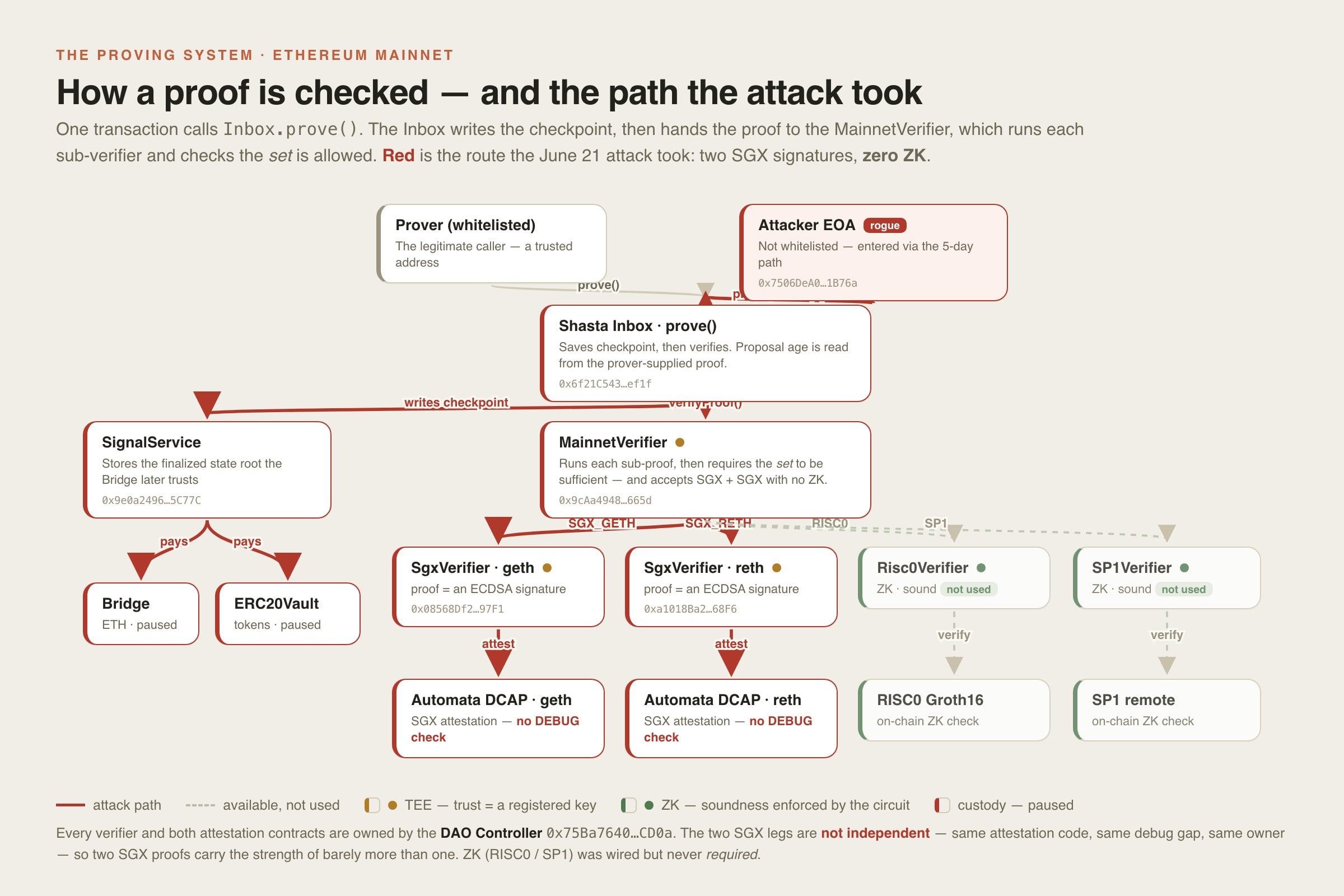
Taiko Labs infographic showing how proofs are checked and the attack path—visualizes the prover/attestation flow and where a forged SGX prover allowed fraudulent L2 state to be accepted (important for understanding risks in based‑sequencing designs). — Source: Taiko Labs (post on Paragraph)
Comparing sequencing designs head to head
| Model | Who decides order | Benefits | Main risks | Notes |
|---|---|---|---|---|
| Centralized L2 sequencer | One operator run by the rollup | Fast confirmations, easy UX, simple builder integrations | Censorship, downtime, opaque MEV capture | Often promises decentralization later |
| Shared sequencer network | External committee or service | Stronger neutrality than single operator, potential fairness rules | New trust surface, coordination complexity, dependency on another network | Think shared infra like emerging SSNs |
| Based rollup | Ethereum proposers via PBS | Inherits L1 proposer decentralization, reduces L2 capture risk | Relay or builder centralization, L1 latency, MEV shifts to L1 | Preconfs become a market |
A quick due diligence checklist
For teams building on a based rollup
- Proofs: Is there a mandatory proof per block or period? What’s the prover throughput and failure handling?
- Data availability: Are batches posted as blobs with clear retention and retrieval tooling?
- Preconfirmations: Who issues them, how are they priced, and what happens on disagreement or reorg?
- MEV policy: Any plans for revenue sharing or app-level protections like inclusion lists or auction rules?
- Bridge policy: Collateralization, circuit breakers, and incident response. Look for post-mortem quality and timelines.
- Monitoring: Track builder share, relay concentration, reorg stats, and blob fee pressure.
For users and integrators
- Set expectations: Soft vs final confirmations should be clear in the UI and in documentation.
- Wallet hints: Surface L1 slot timing and preconf status. Don’t mask it.
- Retry logic: Prepare for rare preconf invalidations. Queue safe resubmits.
- Bridges: Prefer native bridges with transparent accounting and timely audits. Be wary of overly generous caps or incentives.
Mistakes worth avoiding
- Equating based sequencing with full decentralization. PBS relays and builders still matter.
- Marketing speed you can’t back up. If it doesn’t land on L1, it isn’t real.
- Underestimating cross-domain MEV. If your app is arbitrageable, plan for it.
If you want more breakdowns like this without the buzzwords, Crypto Daily tracks these design shifts and their market fallout. You can always catch our latest at cryptodaily.co.uk.
Frequently Asked Questions
Is a based rollup faster than a rollup with a centralized sequencer?
Usually no. Centralized sequencers can issue instant soft confirmations. Based rollups move at Ethereum’s cadence and lean on preconfirmations to feel snappy.
Does based sequencing stop censorship?
It reduces single-operator censorship risk, since no one L2 server controls ordering. But builder and relay concentration under PBS can still bias inclusion. It’s a shift, not a cure-all.
Where does MEV go in a based rollup?
Much of it migrates to L1 builders and proposers who assemble the block that carries L2 batches. Some protocols may add mechanisms to redirect value, but the default gravity is toward L1.
What happens if Ethereum reorgs?
A short reorg can change the canonical L2 batch order. Your L2 client will follow the new L1 chain. Preconfirmations issued on the old view can be invalidated.
Do I still need to trust the bridge?
Yes. Bridge correctness and collateral accounting are separate from sequencing. The Taiko incident and its 1:1 recollateralization before reopening underline that bridges can be the weakest link even for based ZK rollups.
Is a ZK proof per block necessary?
Not strictly for sequencing, but it tightens correctness. Taiko’s Unzen step to require at least one ZK proof per block is a clear move to harden safety beyond ordering neutrality.
Can apps get guaranteed inclusion on a based rollup?
Some designs experiment with inclusion lists or builder commitments. In practice, guarantees are probabilistic until the batch is on L1. Read your rollup’s policy closely.
Disclaimer: This article is provided for informational purposes only. It is not offered or intended to be used as legal, tax, investment, financial, or other advice.
Credit: Source link