

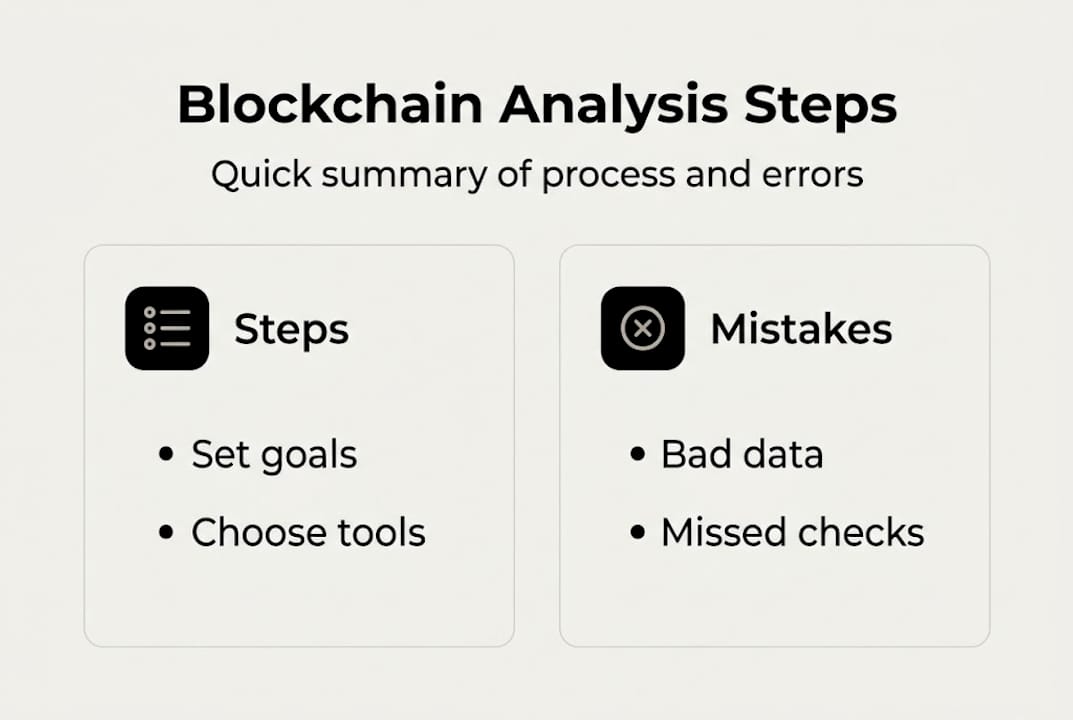
- Effective blockchain analysis requires clear objectives and appropriate data sources for accurate insights.
- Combining multiple tools and validation methods enhances the reliability of on-chain data interpretation.
- Continuous questioning, updating methods, and understanding multi-chain complexities are vital for accurate blockchain analysis.
Mastering blockchain data analysis is no longer a niche skill reserved for compliance teams or elite quant funds. As on-chain activity scales across DeFi, NFTs, and multi-chain ecosystems, the analysts who can cleanly extract, normalize, and interpret blockchain data are the ones who spot trends before the crowd does. This guide walks you through the full workflow, from setting clear objectives and selecting the right tools, to validating your findings and avoiding the analytic traps that trip up even experienced practitioners. Whether you are tracking smart money flows or monitoring DeFi protocol health, the steps here are designed to deliver genuinely actionable insight.
Table of Contents
Key Takeaways
| Point | Details |
|---|---|
| Start with clear objectives | Define what you want to analyze before collecting blockchain data for effective results. |
| Choose the right tools | Select platforms and methods that fit your analysis goals and technical skills. |
| Follow a structured analysis process | Data ingestion, cleaning, clustering, and validation should follow a logical, repeatable sequence. |
| Beware common mistakes | Validate results, watch for overfitting, and understand the limits of heuristics and entity labeling. |
| Keep learning and adapting | The blockchain landscape evolves fast, so update your skills and methods regularly. |
Understanding blockchain data and analysis objectives
Before writing a single query, you need to know what you are actually looking at. Blockchain data exists in layers: raw blocks contain metadata like timestamps and miner rewards, transactions carry value transfers and gas fees, and smart contracts encode programmable logic that governs DeFi protocols and NFT mints. Each layer requires a different extraction and parsing strategy.
Data access points vary in depth and flexibility. Public block explorers like Etherscan and Blockchair are fine for spot checks, but serious analysis demands more. Your main options include:
- Node providers (Alchemy, Infura): Direct RPC access to full chain data, ideal for real-time feeds
- APIs and indexers (The Graph, Moralis): Pre-indexed data that reduces raw parsing overhead
- Data lakehouses (Dune Analytics, Flipside Crypto): SQL-queryable datasets with community-built schemas
- Proprietary platforms (Nansen, Chainalysis): Curated, labeled datasets optimized for compliance or investment research
Defining your objective before touching any data source is the single most important step. Are you tracking fund flows for compliance? Monitoring a whale wallet for trading signals? Studying DeFi liquidity migration? Each goal demands a different scope, covering chain selection, asset class, time window, and granularity. Skipping this step leads to bloated queries, irrelevant results, and wasted compute.
The blockchain use cases shaping 2026 span supply chain traceability, tokenized real-world assets, and decentralized identity, and each requires a tailored analytic approach. Core methodologies for blockchain data analysis include defining analytical objectives, scoping data to specific chains and time periods, accessing data via APIs, node providers, and lakehouses, cleaning and normalizing decoded data, and building scalable analytics stacks with SQL querying and visualization.
| Objective | Recommended data source | Key metric |
|---|---|---|
| Compliance/AML | Chainalysis, TRM Labs | Risk score, entity labels |
| DeFi trend analysis | Dune Analytics, Flipside | TVL, swap volume, LP flows |
| Smart money tracking | Nansen | Wallet PnL, token holdings |
| NFT market monitoring | OpenSea API, Reservoir | Floor price, wash trade ratio |
| Fund tracing | Node RPC, block explorer | UTXO graph, transaction path |
Pro Tip: Write your analysis objective as a single plain-English question before extracting any data. If you cannot state the question clearly, your query will not deliver a clear answer.
Preparing your tools: Essential platforms and setup
Once analysis goals are defined, equipping yourself with the right tools makes all the difference. The blockchain analytics landscape splits roughly into two camps: proprietary platforms built around machine learning and compliance workflows, and open or academic tools centered on SQL querying, custom indexing, and community collaboration.
Industry tools like Chainalysis emphasize proprietary machine learning and clustering for compliance and investigations, while open platforms like Dune and SubQuery focus on SQL-based indexing for DeFi insights. Neither approach is universally superior. Your choice depends on your objective and budget.
Here is a practical comparison:
| Platform | Strength | Best for | Access model | |—|—|—| | Chainalysis | ML clustering, entity labels | Compliance, law enforcement | Enterprise license | | Nansen | Smart money wallets, NFT data | Investment research | Subscription | | Dune Analytics | Community dashboards, SQL | DeFi trend analysis | Free + paid tiers | | SubQuery | Multi-chain indexing | Custom data pipelines | Open source | | TRM Labs | Risk scoring, fraud detection | AML, exchange compliance | Enterprise license |
To get started, follow these steps:
- Define your platform tier. Free tools (Dune, Flipside) work well for exploratory analysis. Paid platforms justify their cost when speed and pre-labeled entity data matter.
- Obtain API access. Sign up, generate your API key, and store it securely in environment variables, never hardcoded in scripts.
- Configure your query environment. For SQL-based platforms, set default schemas and time zone parameters before your first run.
- Build a test query. Pull a small, bounded dataset first (one day, one contract) to validate your setup before scaling.
- Document your stack. Note platform versions, API rate limits, and any known data gaps for reproducibility.
When evaluating blockchain analysis platforms, consider how they handle multi-chain data, since fragmentation across Ethereum, Solana, and layer-2 networks is one of the biggest analytic headaches in 2026. Treating benchmarking analysis tools as a recurring practice, not a one-time setup check, keeps your methodology sharp as data models evolve.
Pro Tip: Blend no-code dashboards for high-level overviews and use custom SQL scripts or Python notebooks for granular deep dives. The combination covers both speed and precision.
Step-by-step process for analyzing blockchain data
With your tools in place, you are ready to follow a proven, step-by-step process. The goal is to move from a raw data dump to a validated, interpretable signal without losing rigor at any stage.
- Define your question. State exactly what you want to know. Example: “Did wallet cluster X accumulate ETH before the Q1 2026 price surge?”
- Extract data. Pull the relevant transactions, block ranges, and contract events using your chosen API or SQL layer. Scope tightly to reduce noise.
- Clean and normalize. Decode hex addresses, convert timestamps to UTC, adjust for token decimals, and remove duplicate transactions from reorgs.
- Analyze. Apply your chosen technique: address clustering, entity resolution, flow tracing, or risk scoring.
- Visualize. Build graph charts for network flows, time-series plots for volume trends, or heatmaps for activity concentration.
- Interpret results. Map findings back to your original question. Decide what is signal and what is noise.
Key techniques include address clustering, entity resolution and labeling, flow analysis for tracing funds, risk scoring, graph visualization for networks, and tracking smart money via wallet performance metrics, exchange flows, and DeFi and NFT activity.
Address clustering is particularly powerful. It groups wallets that likely belong to the same entity by detecting shared inputs in UTXO chains or correlated on-chain behavior in account-based chains. Once wallets are clustered, entity labeling assigns human-readable names (exchange hot wallet, known mixer, VC fund) to those clusters, making flow analysis dramatically more readable. Blockchain transparency makes this process possible, but obfuscation techniques can complicate it significantly.
“Correlation does not equal causation. Identify meaningful signals, not just noise.”
Typical use cases where this process delivers real value include fraud detection (tracing stolen funds through mixing hops), DeFi position analysis (monitoring LP entry and exit behavior), and macro trend monitoring (tracking stablecoin flows between exchanges as a leading indicator of directional market sentiment).
Troubleshooting, validation, and common mistakes
After running your analysis, validation and error-checking become critical to generating real, actionable insight. Raw blockchain data is unforgiving. Small assumptions made during cleaning can cascade into large interpretive errors.
Key validation steps every analyst should run:
- Cross-source verification. Compare your results against at least two independent data sources. Discrepancies often point to decoding errors or schema mismatches.
- Peer review. Share methodology and intermediate outputs with a colleague or the community before publishing conclusions.
- Benchmark against known datasets. The Bitcoin transaction graph, with 252 million nodes and 785 million edges, is a standard reference for GNN node classification and provides a meaningful performance baseline.
- Check for data gaps. Missing blocks or dropped events (common during chain congestion) can skew time-series analysis significantly.
Common mistakes that undermine blockchain analysis:
- Overfitting to heuristics. The co-spend false positive rate can reach 83% in out-of-sample tests, meaning clustering heuristics that appear tight in-sample often collapse against real-world data.
- Ignoring wallet obfuscation. Mixing services, cross-chain bridges, and privacy protocols actively reduce traceability. Treating all flows as transparent is a critical error.
- Misreading graph data. Dense transaction graphs can look like coordinated activity when they simply reflect high-frequency bot behavior on a DEX.
- Ignoring scalability limits. Real-world blockchains now generate petabyte-scale datasets. Pulling unbounded queries against full history is both expensive and slow.
The blockchain trust concerns that practitioners debate most often come down to data integrity and label accuracy. Building validation into your workflow from day one protects both your analysis and your credibility.
What most guides miss about blockchain data analysis
Most technical guides stop at the process. They walk you through data extraction, clustering, and visualization, and then leave you to figure out why your results keep feeling incomplete. The uncomfortable truth is that the quality of your analysis degrades the moment you stop questioning your own methodology.
The transparency complexities of multi-chain ecosystems mean that both centralized and open tools carry blind spots. Proprietary platforms miss emerging protocol patterns that community-built dashboards catch early. Open tools miss the entity labeling depth that enterprise platforms have spent years building. Hybrid analysis, combining both, is your real edge.
Update your methods regularly. Heuristics that worked on Ethereum in 2023 do not automatically transfer to Solana or layer-2 rollups in 2026. Analytic skepticism is not a weakness. It is what separates a reliable analyst from one who chases false leads.
Pro Tip: Build reusable query frameworks and schema templates that you can adapt as new chains and token standards emerge. A modular approach saves significant time when pivoting to multi-chain analysis.
Where to deepen your blockchain analysis skills
Ready to take your analysis further? Crypto Daily provides expert-curated resources to help you stay current as markets and protocols evolve.
For analysts looking to move beyond the fundamentals, following expert crypto strategieskeeps your market read sharp and your frameworks relevant. If you are newer to the space, crypto tips for beginners offers a grounded starting point for building analytic intuition without getting lost in complexity. For a broader market view, the crypto outlook for 2026gives you the macro context that makes on-chain signals more interpretable. Crypto Daily covers every layer of this market so you can analyze with confidence.
Frequently asked questions
What are the most common challenges when analyzing blockchain data?
Wallet obfuscation, co-spend false positives, and petabyte-scale data volumes are the three most persistent challenges, alongside entity labeling errors that misattribute on-chain activity to the wrong actor.
Which tools are best for beginners in blockchain data analysis?
No-code dashboards like Nansen and Dune are ideal starting points, offering fast, visual insights into token flows and protocol activity without requiring programming skills.
How do you validate the accuracy of blockchain analysis?
Validate against benchmark datasets and cross-check findings across multiple independent sources, and be especially cautious of conclusions that rest on a single clustering heuristic or entity label.
What is address clustering in blockchain analytics?
Address clustering groups wallets likely controlled by the same entity by detecting shared inputs or correlated transaction behavior, enabling more accurate flow analysis and risk detection.
Recommended
Disclaimer: This article is provided for informational purposes only. It is not offered or intended to be used as legal, tax, investment, financial, or other advice.
Credit: Source link