
If you’ve explored the crypto space, you’ve probably come across the question “what is Polkadot?” and why it’s often mentioned alongside major blockchain projects. Polkadot is a blockchain platform designed to connect multiple blockchain networks so they can communicate and share information.
Instead of operating as a single chain, the Polkadot network links many specialized blockchains through a shared system. This structure improves scalability and flexibility in blockchain technology while enabling different networks to work together.
Below, you’ll learn how Polkadot works and the problems it aims to address. We’ll also explore the network’s key components, its advantages and challenges, and what the future holds for Polkadot.
What is Polkadot?
Polkadot is a multi-chain platform built to help different blockchains interact with each other. Many blockchains operate independently, which makes it difficult to transfer information or assets between them.
The Polkadot network was designed to change that by creating an environment where many blockchains can run together and communicate easily. Polkadot is often described as a Layer 0 protocol because it sits beneath multiple blockchain networks, enabling them to connect and operate as a single ecosystem.
Rather than forcing every project to run on a single chain, Polkadot allows developers to build their own blockchains while still connecting them to a larger ecosystem. These individual chains can specialize in different tasks such as finance, gaming, or data management.
The History & Team Behind Polkadot
Gavin Wood, one of the co-founders of Ethereum and the former Chief Technology Officer (CTO) of the Ethereum project, created Polkadot. After helping build Ethereum, Wood began exploring ways to improve how blockchain networks communicate with each other.
He introduced the idea of Polkadot in 2016, with the goal of building a system that would allow many blockchains to operate together rather than compete as isolated networks.
The project is developed by Parity Technologies, a company focused on blockchain infrastructure. It is also supported by the Web3 Foundation, a nonprofit organization that promotes decentralized internet technologies.
Polkadot officially launched its main network in 2020, and since then, it has grown into one of the most recognized projects in the crypto ecosystem.
What Problems Polkadot Is Designed to Solve?
Several challenges have slowed the growth of blockchain technology. Polkadot was designed to tackle many of these issues through its multi-chain architecture.
- Interoperability: Most blockchains operate independently and cannot easily communicate. For example, Bitcoin (BTC) cannot directly interact with Ethereum (ETH), and Ethereum cannot natively connect with Solana. The Polkadot network links different blockchain networks so they can share data and assets.
- Scalability limitations: Many blockchains slow down when too many users join the network. Polkadot spreads activity across multiple connected chains, which allows the system to process far more transactions at the same time.
- Security challenges for new blockchains: Launching a new blockchain usually means building a security system from scratch. Polkadot allows new chains to share the network’s existing security, which helps smaller projects launch safely and faster.
- Difficult upgrades and network splits: Some blockchain upgrades require major changes that can divide communities. Polkadot enables proposed software upgrades through on-chain governance, allowing DOT holders to vote on improvements without disrupting the network.
- Lack of specialization: Many blockchains try to handle everything on one chain. Polkadot allows different chains to focus on specific purposes such as finance, gaming, identity, or data services.
How Does Polkadot Work?

The Polkadot network works by linking multiple blockchains into a single, coordinated system. Instead of running everything on a single chain, the network allows different blockchains to operate independently while still sharing security and communication.
At the center of the system is the Polkadot relay chain that coordinates activity across the network. Other connected chains handle specific tasks and applications.
This design allows the network to process many transactions at the same time, which can improve speed and scalability. Because each blockchain focuses on its own role, the overall system becomes more efficient.
Key Components of the Polkadot Ecosystem
To understand how Polkadot achieves interoperability, scalability, and security, it helps to look at the core pieces that make up the network:
1. Relay Chain
The relay chain is the core of the Polkadot network. It coordinates communication between connected chains and maintains overall security. Instead of handling complex applications directly, the relay chain validators validate transactions and ensure the network runs smoothly.
2. Parachains
Parachains are independent blockchains that connect to the Polkadot network. Each parachain can be designed for a specific purpose, such as decentralized finance, gaming, identity management, or data storage. Because they operate in parallel, parachains increase the network’s overall capacity.
3. Parathreads
Parathreads are similar to parachains but operate on a more flexible basis. Instead of maintaining a constant network connection, they pay for access only when needed. Parathreads make Polkadot accessible to smaller projects that are not yet at a scale to justify the cost of a full parachain slot, lowering the barrier to entry for developers building on the network.
4. Bridges
Bridges allow the Polkadot network to connect with other blockchain ecosystems. Through bridges, information and digital assets can move between Polkadot and other major blockchains like Bitcoin or Ethereum. This helps expand the network’s usefulness by linking it to the broader crypto ecosystem.
5. Substrate – Building
Substrate is a development framework that makes it easier to build new blockchains for the Polkadot ecosystem. Developers can use it to design customized blockchain networks that seamlessly connect to Polkadot. The framework speeds up development and lets teams focus on building applications rather than starting from scratch.
Polkadot vs. Ethereum: What’s the Difference?

Polkadot and Ethereum are often compared because of their shared heritage; Gavin Wood co-founded Ethereum before leaving to build Polkadot. But they represent fundamentally different philosophies about how blockchains should be structured.
| Feature | Ethereum (ETH) | Polkadot (DOT) |
| What it is | Decentralized smart contract platform and Layer-1 ecosyste, | Layer-0 protocol designed to connect multiple blockchain networks |
| Consensus | Proof of Stake (Ethereum 2.0) | Nominated Proof of Stake (NPoS) |
| Scalability | Uses Layer-2 solutions and future sharding plans | Uses parachains that process transactions in parallel |
| Utility | Gas fees, crypto staking, DeFi, NFTs, and smart contracts | Governance, staking, and cross-chain communication |
| Tokenomics | Inflationary supply with a fee burn mechanism | Inflationary supply with staking incentives |
| Community | Large open-source developer community | Developer-focused ecosystem built around multi-chain connectivity |
Benefits and Limitations of Polkadot
Before deciding if Polkadot is right for your crypto strategy, it’s helpful to weigh what sets it apart and where it faces challenges:
Benefits That Set Polkadot Apart
Advantages that make Polkadot stand out in the blockchain space are:
- True cross-chain interoperability: Polkadot lets different blockchains share tokens and data with each other, something most other networks cannot do on their own.
- Shared security: New parachains automatically use the security of the entire Polkadot network, so small projects don’t have to set up their own validator groups.
- Parallel processing: Multiple parachains run at the same time, letting Polkadot handle far more transactions than a single-chain system.
- Forkless upgrades: The network can update itself through on-chain governance without splitting the community.
- Developer flexibility: The Substrate framework makes building a custom blockchain faster and cheaper than starting from scratch.
Limitations and Challenges to Consider
Despite its strengths, Polkadot faces certain limitations and challenges:
- Complexity: Polkadot’s setup is more complicated than single-chain networks, which can make developers prefer Ethereum or its Layer-2 solutions.
- Parachain slot competition: Getting a parachain slot requires locking up large amounts of DOT through crowdloans, which can be costly and complicated for new teams.
- Strong competition: Networks like Cosmos, Avalanche, NEAR, and Ethereum Layer-2 solutions offer similar features, often with better compatibility for Ethereum apps.
- Adoption pace: Even with over 1,000 dApps, real-world usage and developer activity have lagged behind other chains.
What Is the DOT Token?
The DOT token is the native cryptocurrency of the Polkadot network. It plays an important role in maintaining the ecosystem and allowing participants to interact with the platform. The Polkadot token helps coordinate governance, secure the network, and support the creation of new parachains.
Governance
DOT holders can participate in decision-making within the Polkadot network. This includes voting on upgrades, changes to network rules, and funding proposals. Such a governance model allows the community to help guide the development of the platform.
Staking and Network Security
DOT holders can stake their crypto tokens to help secure the Polkadot network and earn dot rewards. Staking DOT tokens strengthens security, making attacks harder. Holders can stake directly or nominate trusted validators, supporting transaction validation and network stability while encouraging long-term commitment.
Bonding for Parachains
Projects that want to run their own parachain on Polkadot must bond DOT for the duration of the slot lease (typically 96 weeks). They collect this DOT through crowdloans, where community members temporarily loan their DOT to support a project in exchange for rewards in the project’s own token. When the slot lease expires, the bonded DOT is returned in full to those who contributed.
DOT Price Overview and Market Predictions
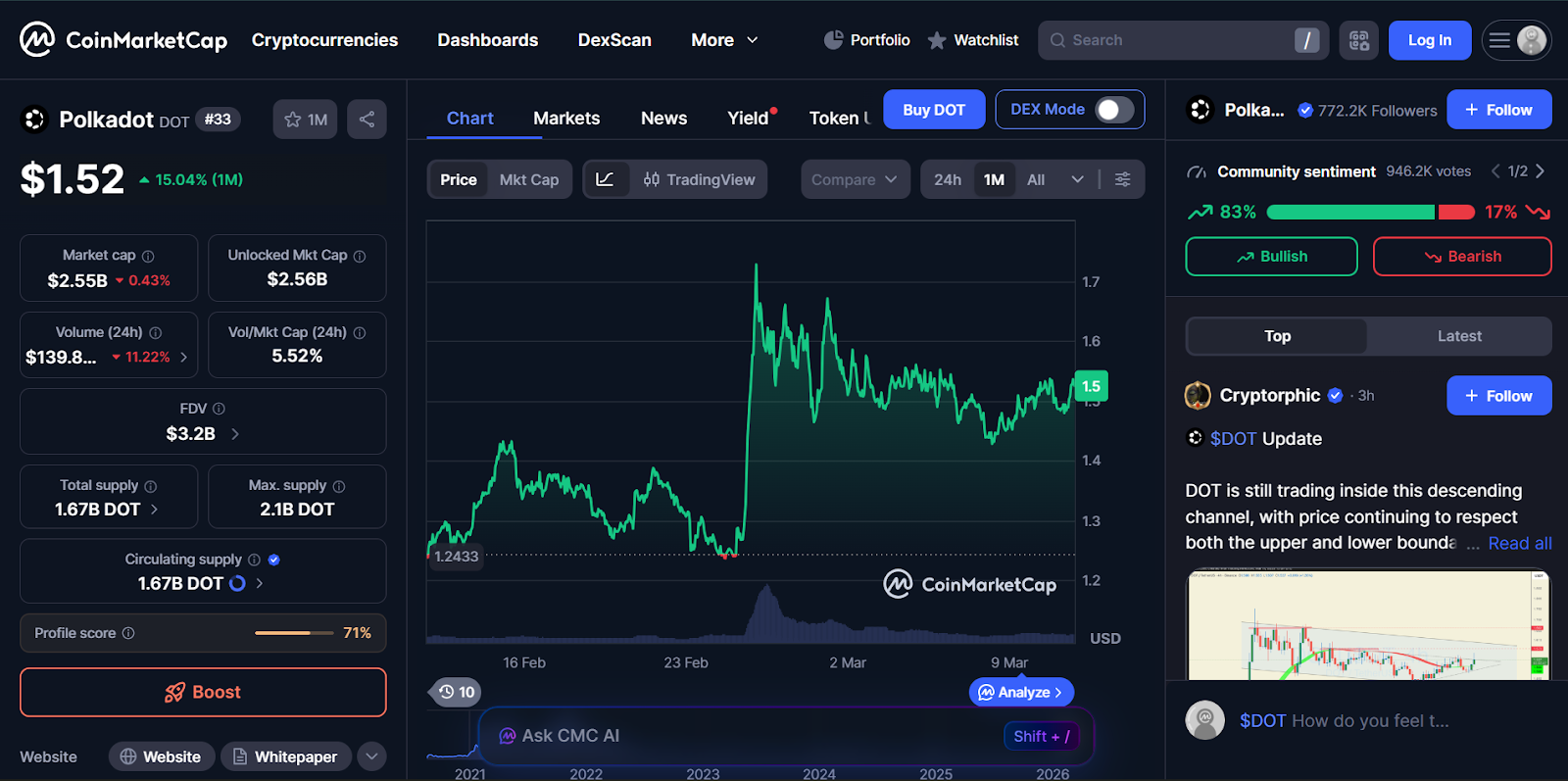
DOT reached an all-time high of around $57.50 in May 2021, driven by the crypto bull market and the excitement around parachains. Since then, it has fallen, trading near $1.50-$1.60 as of early March 2026.
- Short-term sentiment is broadly bearish, with technical indicators suggesting downward pressure and the 50-day moving average sitting above the price. However, the 200-day moving average has shown some early signs of recovery.
- Conservative 2026 predictions range from $1.15 to $2.01 under a gradual market recovery.
- Bullish forecasts suggest $7-$8 if DOT breaks resistance near $3.50-$4.00 and the broader market rallies.
- Long-term projections see $10-$25 by 2029-2030 if adoption and interoperability grow.
Overall, DOT’s future will depend on network adoption, parachain growth, and broader market trends.
How to Buy and Store DOT
If you’re exploring DOT as one of the best cryptocurrencies to buy for your portfolio, follow these steps:
- Choose an exchange: DOT is listed on major exchanges, including Coinbase, Binance, Kraken, KuCoin, Bybit, and many others. Pick one available in your region.
- Create and verify your account: Sign up with your email and complete identity verification (KYC), which is standard on regulated platforms.
- Deposit funds: Add money via bank transfer, credit card, or existing crypto. USDT and BTC are the most common pairs for buying DOT.
- Buy DOT: Search for DOT/USDT or DOT/USD and place your order. Market orders buy at the current price, while limit orders let you set your target.
After buying, it’s important to store your DOT safely.
- For small amounts or active trading, keeping DOT in a custodial wallet provided by your exchange is fine.
- For larger holdings, personal crypto wallets give you direct control of your tokens. The Polkadot.js browser extension is the official wallet and works well for staking and governance.
- Hardware wallets such as Ledger and Polkadot Vault provide maximum security for long-term storage.
- Other popular options include Talisman and SubWallet for browser wallets, and Nova Wallet for mobile, which offers a clean interface and built-in staking support.
Conclusion
Polkadot is designed to bring multiple blockchain networks together into a single ecosystem. By connecting independent chains through a shared infrastructure, the Polkadot team aims to improve scalability, flexibility, and communication across blockchain technology.
As adoption grows, Polkadot could play an important role in the future of multi-chain blockchain ecosystems. For developers and investors interested in interoperability and scalable blockchain networks, it remains one of the most closely watched projects in the industry.
FAQs
Polkadot could be a good investment if you believe in the long-term potential of interconnected blockchain networks. Like all cryptocurrencies, it carries risk, so research carefully before committing. Consider it more as a long-term play than a quick trade.
Polkadot is designed to connect multiple blockchains, allowing them to share data, assets, and applications. It creates a unified ecosystem where projects can interact without relying on a single chain. This makes blockchain technology more flexible and scalable.
Polkadot and Ethereum serve different goals. Ethereum focuses on decentralized applications and smart contracts, while Polkadot focuses on connecting blockchains. Choosing one depends on whether you value multi-chain interoperability or a single-chain dApp ecosystem.
The relay chain is the central hub that secures and coordinates the entire network. Parachains are independent blockchains that run specialized applications and handle transactions. Together, they allow multiple chains to work efficiently under shared security.
You can store DOT in hardware wallets like Ledger for maximum security. Browser wallets like Polkadot.js, Talisman, or SubWallet are great for staking, while mobile options like Nova Wallet make managing DOT easy on the go.
DOT reaching $100 depends on market conditions, adoption of the network, and broader crypto trends. While possible, it would require strong growth in parachain usage and overall blockchain interoperability adoption. Always consider risks before speculating.
Credit: Source link